The Cricket Sweater and the Shape of Club Style
Cricket sweater style can feel formal, dated, or hard to place. Learn how its shape, trim, and club context signal belonging without requiring a full uniform.
Why does a cricket sweater look like club dress even when nobody is wearing a tie? Cricket sweater style rests on a few visible choices: a knitted body, a collar or V-neck, and trim that can mark a team without turning the garment into a signboard. Trouble starts when those choices are treated as fixed rules rather than clues to how cricket has presented itself.
The sweater’s visual identity is less a matter of one correct pattern than of a balance between useful clothing and public formality. A club garment can be warm, wearable, and recognisable at once. It can also look borrowed from another era if its details are copied without considering where, and by whom, it will be worn.
The sweater carries club style through shape and restraint
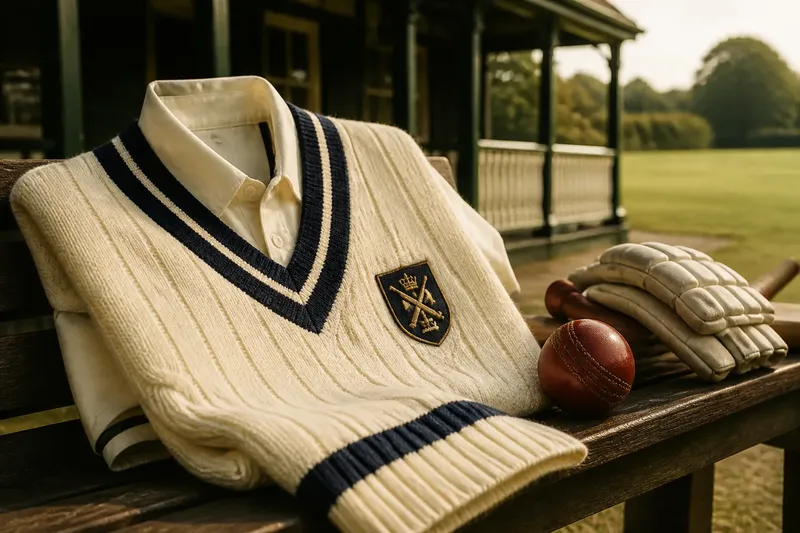
The familiar cricket sweater has a clear silhouette. A V-neck leaves room for a shirt collar and tie; a sleeveless slipover keeps the arms free while preserving a tidy torso. A long-sleeved version reads as warmer and more complete, with ribbed cuffs and hem holding the outline in place. The shape makes the garment legible before anyone notices a crest.
That legibility is part of its appeal. A sweater can suggest that a player belongs to a side or club without the visual weight of a jacket. Its knit surface softens the formality of a collared shirt, while a neat neckline keeps the result from becoming ordinary weekend knitwear. The design sits between uniform and personal clothing, which is precisely why small differences matter.
Traditional details often include a pale ground, contrasting bands, a club badge, or a narrow stripe at the neckline and cuffs. None is compulsory. A broad band may dominate the sweater, while a restrained edge can make the same colors feel quieter. A badge placed on the chest gives the garment an explicit affiliation; without it, the colors and cut do more of the work.
Color and trim can make the garment feel either formal or casual
Color is often the first source of uncertainty. A white or cream sweater can call to mind ceremonial club dress, but it also shows dirt readily and may feel too deliberate for ordinary wear. Darker colors can make a cricket-inspired sweater easier to use off the field, though a dark body with bright bands can still look conspicuously like team kit.
Trim changes the tone as much as the base color. Narrow bands create a clear border and tend to keep the body visually calm. Multiple wide stripes pull attention toward the chest and sleeves. A single accent color usually reads as considered; several competing colors can make the sweater resemble a collection of club decisions made in different rooms.
When selecting colors, start with the setting rather than an imagined ideal. For match-day wear, the club’s established colors may matter more than personal preference. For a general cricket reference, a neutral body and one contrasting stripe can retain the association without implying membership in a particular club. If the garment will carry a crest, leave enough visual space around it for the badge to remain distinct.
The wrong fit can make a classic shape look borrowed
A sweater can be historically suggestive and still sit badly on its wearer. A V-neck that drops too low exposes more shirt than intended. A tight band at the waist can bunch over trousers, while a very loose body loses the clean outline that gives the garment its club-like character. Sleeves that cover the hands can make a formal knit look simply ill-fitting.
Check the shoulder seam, neckline, body length, and ribbing while wearing the shirt that would normally sit beneath it. The collar should lie neatly outside the V rather than disappear under it. The hem should meet the waistband without riding up when the wearer reaches or bends. The right amount of ease depends on whether the sweater is a close-fitting layer or a relaxed outer knit.
Say you are choosing a navy sweater with a cream V-neck for a club gathering, and its shoulders fit but the hem falls well below the hips. Trying a shorter cut with the same colors would likely restore the compact, orderly outline without changing the club reference. The observable difference is in the silhouette, not in a claim that one version is more authentic.
Common cricket sweater problems have practical fixes
Most style problems come from a mismatch between the garment’s cues and its intended setting. Before replacing a sweater, identify which cue is causing the trouble: shape, color, insignia, or condition. A small adjustment to the surrounding clothes may solve more than a new knit does.
- It looks too much like a costume. Several bold bands, a large crest, and a sharply contrasting collar can all compete. Keep the sweater as the main club signal and simplify the shirt, tie, and outer layer around it.
- It looks like generic schoolwear. A plain V-neck and dark piping may lack a clear cricket reference. A restrained club color, a knit texture, or a discreet chest badge can provide context without adding every traditional detail at once.
- The badge appears crowded. A large emblem near a stripe or deep neckline can make the chest feel busy. Choose a smaller badge or a quieter placement, and avoid adding another decorative mark nearby.
- The sweater feels too formal for the occasion. A tie, pressed shirt, and pristine knit together can suggest a dress code even where none exists. Remove one formal element, usually the tie, while keeping the sweater’s collar and trim tidy.
- The colors seem to clash. The shirt collar, tie, and sweater bands may each introduce a separate accent. Keep the shirt quiet and use one color already present in the trim for any additional detail.
- The knit looks tired. Pilling, stretched ribbing, and a sagging neckline weaken the garment’s shape. Use a fabric comb for surface pills where the yarn allows it, and follow the care label for washing and drying rather than pulling the knit into shape while wet.
Not every flaw deserves a repair project. Replacing a tiny, hidden loose thread or trying to recreate an exact vintage stripe is rarely worth the effort if the sweater is comfortable and its overall shape remains sound. Preserve the parts that carry meaning; do not turn ordinary wear into a museum emergency.
Club identity depends on who wears the sweater and where
The garment can signal belonging, but belonging is not produced by color alone. A club crest, agreed team colors, or a shared dress convention makes the connection explicit. A sweater in similar colors without those cues may simply be cricket-inspired. The distinction matters when choosing clothing for a club event, a match, or everyday use.
Formality also changes with context. A sweater worn over whites on the boundary reads differently from the same knit worn with jeans on the way to a ground. In one setting, it participates in a coordinated appearance; in another, it borrows the game’s visual language. Neither use cancels the other, but they ask for different levels of trim and polish.
For a club garment, ask whether the group has an established crest or color convention before adding one. For personal wear, avoid using a specific club emblem unless it is yours to wear. These choices keep the difference between affiliation and appreciation clear without making clothing carry more social weight than it can bear.
What should you look for before choosing a cricket sweater?
Should a cricket sweater have a V-neck?
A V-neck is the clearest traditional choice because it frames a shirt collar and leaves room for a tie. A crew neck can work as a cricket-inspired knit, but it loses some of the familiar club-dress outline.
Does a cricket sweater need a crest?
No. A crest makes club affiliation unmistakable, while color and trim can suggest the style more generally. Use an emblem only when the wearer has a legitimate connection to that club.
Can a cricket sweater be worn casually?
Yes, especially when the color scheme is restrained and the fit is comfortable rather than sharply formal. Pairing it with a plain shirt or simple trousers lets the knit read as clothing first and club reference second.
How should a cricket sweater be cared for?
Check the fiber and care label, since wool, cotton, and blended knits can respond differently to washing and drying. Store it folded rather than hanging if the knit is prone to stretching at the shoulders.
The best cricket sweater keeps its references in proportion
Cricket sweater style works when its details form a coherent whole: a recognizable shape, trim with a clear role, and a level of formality suited to the wearer and occasion. A club sweater can preserve a shared visual identity; a personal knit can borrow that identity more lightly. In either case, the garment’s shape is doing as much as its colors.
When the sweater feels wrong, adjust the most conspicuous mismatch first. A quieter tie, a better-fitting cut, or less crowded trim can restore the balance without erasing the cricket reference. The useful question is not whether the garment looks old-fashioned, but whether its signs of club style are being worn deliberately.