Why the Crease Is a Drawing, Not Just a Line
Cricket crease markings make the pitch easier to read: learn what each line shows and how to follow a close call from the boundary.
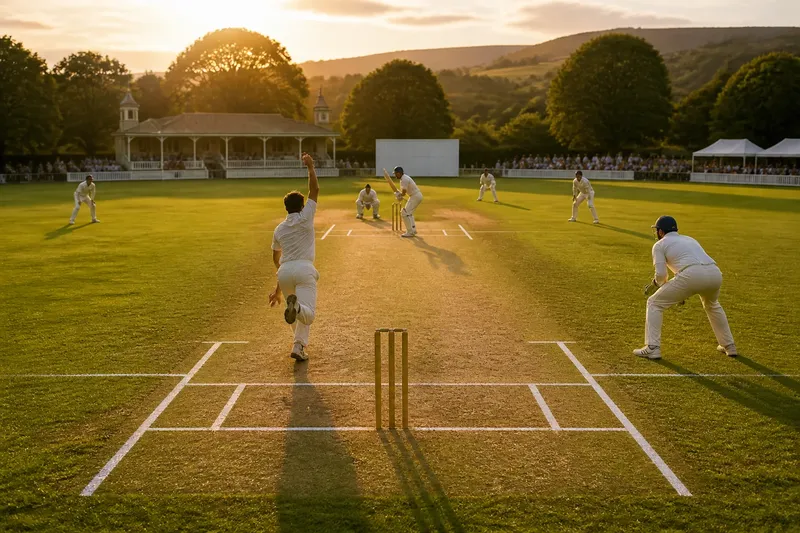
Why do cricket crease markings look like a small diagram rather than one boundary? At the stumps, the popping crease and return creases give players and viewers visible reference points for reading position on the pitch.
The popping crease anchors the layout
The stumps provide the central landmark at each end of the pitch. The popping crease runs across the pitch in front of them, extending beyond the outer stumps. That extension matters when judging a batter’s ground: the relevant reference is not confined to the narrow space between the stumps.
The return creases meet the popping crease and extend back on either side. They make the layout around the wicket easier to see and provide a visual reference for the bowler’s position. They should not be treated as a complete boundary that, by itself, settles every question about a delivery.
The lines work together as a visual map
Start at the stumps, follow the popping crease across the pitch, then trace the return creases away from it. The marks show direction and alignment: across the pitch, back from the popping crease, and centered on the wicket.
The basic arrangement is repeated at the other end. From the boundary, that repetition helps restore the shape when a patch of paint is worn or difficult to see. The stumps and the pitch’s lengthwise alignment are useful guides; a faint stripe need not be read in isolation.
Follow the reference point in a close call
Say you are watching a run-out appeal from behind the bowler’s arm. A batter stretches the bat toward the popping crease as a fielder breaks the wicket. The line gives you a visible point to compare with the grounded bat, while the stumps show which wicket is involved. The umpire applies the playing laws to the precise circumstances; the paint helps viewers see what is being judged.
For a delivery, notice the bowler’s front foot in relation to the popping crease. Its position can matter to a no-ball decision. The return creases add a visual frame for the bowler’s position, but the markings alone do not determine every aspect of the delivery.
What do cricket crease markings show?
What is the popping crease for?
It provides a visible reference across the pitch near the stumps, including when judging whether a batter has made ground. Its painted extension beyond the stumps means the reference spans wider than the wicket itself.
What do the return creases show?
They extend back from the popping crease and help make the bowler’s position easier to read. They are a visual frame, not a standalone explanation of every delivery decision.
Are the markings repeated at both ends?
The basic crease arrangement appears at each end of the pitch. That lets players and viewers use the same visual references whichever way play is moving.
Does touching a painted line settle every decision?
No. The markings provide reference points, while the playing laws and details of the action govern the decision. A close call can depend on what is grounded and when the wicket is broken.
What the paint cannot tell you
Do not treat every stripe as a separate rule, or assume that paint alone explains a decision. The markings are a compact drawing, not a full diagram of cricket law. A long debate over a scuffed edge is rarely useful until you have identified the relevant line, the player’s position, and the moment being judged.
To read cricket crease markings from the stands, start with the stumps, trace the popping crease across the pitch, and follow the return creases back. The useful distinction is simple: the paint makes position visible, while the playing laws determine what that position means in a particular situation.